
What are you looking for?
Where did you receive care?
-
MyVirginiaMason has been replaced with the CommonSpirit Patient Portal.
Learn more. -
Virginia Mason Medical Center & regional centers
Log in to Commonspirit Patient Portal > -
All other locations
Log in to VMFH MyChart >

Virginia Mason Franciscan Health Achieves U.S. First: ECMO and Hyperbaric Oxygen Therapy Delivered Simultaneously to Save a Life
Jan. 13, 2026
In a pioneering medical achievement, Virginia Mason Franciscan Health (VMFH) successfully saved the life of a critically ill patient, combining two powerful and proven treatment options for those experiencing heart and/or lung failure: Extracorporeal Membrane Oxygenation (ECMO) and Hyperbaric Oxygen Therapy (HBOT). This is believed to be the first documented instance of using ECMO and HBOT concurrently in the United States.
"The patient presented with a very severe case of carbon monoxide poisoning,” noted Nick Bird, MD, director for the Center for Hyperbaric Medicine at Virginia Mason Medical Center (VMMC). “Their cardiac function was so compromised that the standard approach for hyperbaric oxygen therapy would have been extremely high-risk. We needed an immediate, simultaneous intervention that addressed both the carbon monoxide poisoning and their failing heart."
ECMO is typically used with patients experiencing heart and/or lung failure. HBOT may treat a variety of conditions—from severe carbon monoxide poisoning to a diver battling decompression sickness or a patient struggling with a wound that refuses to heal.
This unprecedented combination of life support resulted in a dramatic recovery for the 27-year-old patient. Today, they are well on the way to recovery—a dramatic turnaround from a near-death state.
A Groundbreaking Intervention
The care team, driven by years of deep experience in combined hyperbaric medicine and critical care interventions, made the decision to place the patient on ECMO to facilitate hyperbaric oxygen therapy given their critical state.
This complex procedure involved:
ECMO: An "artificial lung and heart" that bypasses the patient's compromised organs, directly oxygenating their blood and circulating it throughout their body. ECMO has been a vital tool in critical care since the 1970s, providing life support when a patient's own heart and lungs fail.
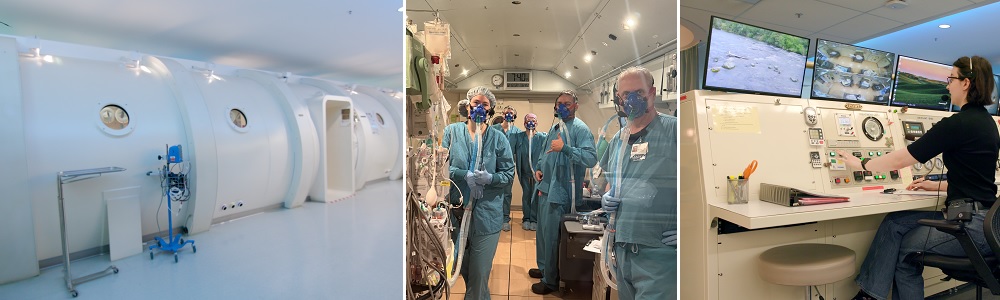
HBOT: Breathing 100% oxygen at increased atmospheric pressure drives oxygen deeply into tissues, which helps to reverse the effects of carbon monoxide poisoning, reduce inflammation and promote healing at a cellular level.
"This patient arrived at a critical juncture for our team," said Ashwin Gopalan, MD, a key leader in this innovative approach since joining the hyperbaric team. "For months, in collaboration with Dr. Blake Mann, Dr. Nicholas Bird, and a multidisciplinary team, we had been evaluating the use of an ECMO machine, along with other supportive critical care devices, including a specialized ultrasound and ventilator, inside the hyperbaric chamber. This preparation allowed us to act decisively when it mattered most."
Foresight and Collaboration
The successful treatment was not a spontaneous act, but the culmination of foresight and collaborative effort. The team's readiness for such a complex scenario centered on both proactive research and cross-training including:
Extensive testing: Rigorous simulations and evaluations were conducted to ensure the safety and efficacy of combining ECMO with HBOT, particularly regarding the specialized equipment required inside the pressurized environment.
Multidisciplinary expertise: Physicians, nurses, respiratory therapists and ECMO specialists from critical care and hyperbaric medicine departments underwent specialized training, ensuring every team member was proficient in this unique workflow.
Lessons from local collaboration: Recent collaboration with Seattle Children's, specifically in the care of a child requiring critical ventilation in the hyperbaric chamber, provided invaluable insights and further refined VMMC's protocols for pediatric and adult hyperbaric critical care.
The team's ongoing focus on advancing ECMO care at VMMC, coupled with their deep understanding of hyperbaric medicine, played a crucial role.
"This achievement underscores the dedication, compassion, and ingenuity of our hyperbaric and critical care teams at Virginia Mason Medical Center," added Dr. Bird. "It was truly about putting the patient at the center of care and leveraging every possible innovation to provide them with the best chance of survival and recovery."
A History of Clinical Excellence
Virginia Mason Franciscan Health continues to push the boundaries of critical care, providing hope and cutting-edge treatments to those facing life-threatening conditions across Washington state, and neighboring communities in Alaska, Oregon, Idaho and Montana. The organization just celebrated its 100th ECMO procedure.
The Center for Hyperbaric Medicine at VMMC is staffed by some of the nation's most experienced and highly trained teams. Since 2006, it has maintained Level 1 with distinction accreditation from the Undersea and Hyperbaric Medical Society (UHMS)—the highest level achievable. This prestigious accreditation signifies a dedication to the highest standards of safety and clinical excellence.
This groundbreaking case sets a new standard for future interventions that can transform patient outcomes.
About Virginia Mason Franciscan Health
Virginia Mason Franciscan Health (VMFH) is an integrated health system serving the Puget Sound region, including 10 hospitals and 300 care sites. Founded in 1891, VMFH embraces its long history of caring for the most vulnerable, especially the poor and underserved, and meeting the evolving health care needs of the vibrant, diverse communities it serves. VMFH is a proud home to the Bailey-Boushay House, the first skilled nursing and outpatient chronic care management program in the United States designed specifically to meet the needs of people with HIV/AIDS, and the Benaroya Research Institute, an internationally recognized institution for autoimmune disease research. VMFH is part of CommonSpirit, one of the nation’s largest health systems, dedicated to advancing health for all people.