
What are you looking for?
Where did you receive care?
-
MyVirginiaMason has been replaced with the CommonSpirit Patient Portal.
Learn more. -
Virginia Mason Medical Center & regional centers
Log in to Commonspirit Patient Portal > -
All other locations
Log in to VMFH MyChart >

A Faulty Heart Valve Brought Them Together; Hockey Connected Them
March 2026
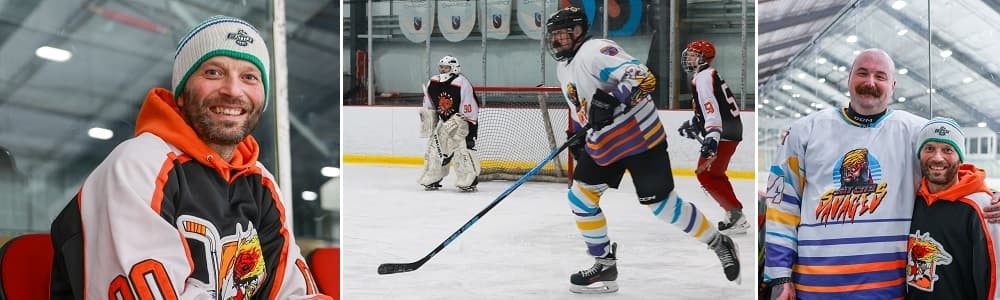
When 46-year-old Clayton Brennan arrived at the hockey rink on May 6, 2025, the day felt like any other. He laced up his hockey skates and joined his team on the ice. Clayton took up hockey as an adult, and he quickly fell in love with the sport. He got invited out to play one day and the comradery he felt with his teammates kept him coming back. Every week, he would drive to the rink to play in the adult hockey league with his fellow Fire Ants. It was something he looked forward to every week.
Moments after the puck was dropped in the center of the ice, Clayton collapsed.
Seconds ticked by and he didn’t get up. He lay motionless on the ice.
Three men from the opposing team skated over, luckily they all had medical backgrounds, including Scott Clemons, ARNP, medical director at Franciscan Medical Clinic, VMFH clinic in Lakewood.
Scott and two others from his team, Lieutenant Matt West, City of Snoqualmie Fire Department, and U.S. Navy Lieutenant Commander Dr. Jonathan Volland, Diplomate, American Board of Oral and Maxillofacial Surgery, skated over to assess Clayton. At first, they thought maybe he simply had a musculoskeletal injury, a common injury when playing hockey, but his teammates cried out in panic, “he’s having a seizure.”
They rolled Clayton on his side and realized the situation was much more dire.
“A type of breathing reflex happens when blood is not getting to the brain,” said Clemons. “It has a very distinct sound. It’s called agonal breathing. We heard it, looked at each other, and I thought to myself, ‘this is actually happening.’”
Immediately, Scott ripped off Clayton’s helmet and jersey, yelled for someone to get an automated external defibrillator (AED), and began CPR. An AED is a medical device designed to analyze the heart rhythm and deliver an electric shock to help restore a person’s heart rhythm to normal.
Another individual called 9-1-1, and notified the three men working to save Clayton’s life that an ambulance was on the way. Scott placed the pads from the AED on Clayton’s chest, and they waited for the device to tell them what to do next.
“Shock advised,” the device announced.
Clayton had no heartbeat. A shock was administered.
When the ambulance arrived, a fury of medical professionals stabilized Clayton, and after what felt like a whirlwind, he was whisked away to St. Joseph Medical Center in Tacoma.
"I was worried about him,” said Clemons. “The days following, I was just thinking, ‘I hope he's okay.’ You replay it in your head. Were my compressions deep enough? I was very thankful when I found out he recovered. It could have gone a completely different direction.”
At St. Joseph Medical Center, Clayton met another avid hockey player, Dr. Craig Hampton, a cardiac surgeon who specializes in mitral valve repair.
Years before Clayton collapsed, he went to the doctor for a check up. He found out he had a heart murmur, but it was something he put to the back of his mind, not worrying too much about it. In April, about a month before his heart stopped, he said there were a few instances when he felt lightheaded while he was playing.
“That was one of the signs,” he recalled, “but I didn’t think anything of it.”
In the emergency room, the care team at St. Joseph met to devise a treatment plan for Clayton. His unique case required specialists from a multidisciplinary team, composed of emergency medicine physicians, cardiac care physicians and others. There were a couple options for treatment.
Mitral valve prolapse is a type of heart valve disease that affects the valve between the left heart chambers. It’s the most common heart valve condition in adults, and in some cases can cause sudden cardiac arrest.
In Clayton’s case, his heart valve was allowing blood to leak backward, called regurgitation, which caused the heart murmur.
“My valve was acting like one of those balloons you see in front of car lots, it was just waving wildly about,” said Clayton.
“When he got to the hospital and we completed the evaluation, we had to figure out if we should fix the valve or if we should put in a defibrillator as initial therapy,” said Dr. Hampton. “We decided as a team to put in a defibrillator first, to protect him in the future. In the event he had another fatal arrhythmia, it would shock him. I felt the safest thing was to get a defibrillator, then subsequently have a mitral valve surgery and get him back to life. We knew it was necessary to repair his heart valve to get his heart working normally again, and we knew if we fixed the valve, it would enhance his quality of life.”
So, that was the goal. Place a defibrillator to ensure his heart didn’t stop again, and then fix the issue with his valve.
Mitral valve prolapse is the most common valve disorder in adults in the United States. Dr. Hampton says about 2 to 3 percent of the population has mitral valve prolapse.
“It’s a very common problem in the population,” said Dr. Hampton. “But despite that, everyone’s valve is unique and a little different, including his. He has a unique valve. If you have mitral valve prolapse, you need to see a specialist. It’s important to raise awareness. Around 12 million Americans could have mitral valve prolapse. Within that group, up to 300,000 people could have the type of mitral valve prolapse that are at increased risk of cardiac arrest – and they may not even know about it.”
Most cardiac specialists may only see a few mitral valve patients a year. Dr. Hampton sees mitral valve patients every day. Along with an experienced cardiac care team, they tailor each treatment plan to each unique individual, putting the patient at the center of care.
After Clayton got a defibrillator, Dr. Hampton visited Clayton.
“After the first surgery, Dr. Hampton came into my hospital room,” said Clayton. “He told me I had a bad heart valve, and he told me when I got healed up, we’d schedule a mitral valve repair. He was really thoughtful about getting me back out on the ice.”
“We bonded over hockey,” said Dr. Hampton. “I’ve played hockey my whole life. It’s the greatest sport there is.”
With the defibrillator, Clayton wouldn’t be able to play again. Dr. Hampton assured him he’d get him back to the sport he knew Clayton enjoyed playing.
A few months later, Clayton came back to St. Joseph Medical Center for a minimally invasive mitral valve repair. The surgery was a success.
The VMFH cardiac surgery teams in Tacoma are among the few in the United States that offer minimally invasive mitral and tricuspid valve repair and replacement. The innovative technique involves a small incision, resulting in less pain and scarring and a faster, easier recovery.
“I’m blessed,” said Clayton. “The care team was great.”
After Clayton’s mitral valve repair, he was able to get back to playing hockey.
He brought his care team donuts, and he even gave Dr. Hampton a Fire Ants shirt.
“I keep begging him to be on the team,” said Clayton, “but I think he might be too good,” he joked.
In December, Clayton rejoined his team and played his first game back at the same rink where he collapsed.
“I got a second chance,” he said.
“His outcome was amazing,” said Scott. “I'm so glad he's okay.”
When asked if he’s going to take it easy on Clayton’s team the next time they play, he laughed. The team might not be checking him against the boards as hard.