
What are you looking for?
Where did you receive care?
-
MyVirginiaMason has been replaced with the CommonSpirit Patient Portal.
Learn more. -
Virginia Mason Medical Center & regional centers
Log in to Commonspirit Patient Portal > -
All other locations
Log in to VMFH MyChart >
Game-Changing Technology Means Earlier Lung Cancer Detection, Lives Saved
Virginia Mason Franciscan Health is now home to a powerful new tool in the fight against lung cancer. The state-of-the-art device assists with the expedited diagnosis of lung cancer at its earliest stages, leading to more immediate treatment, improving patients' chances of survival.
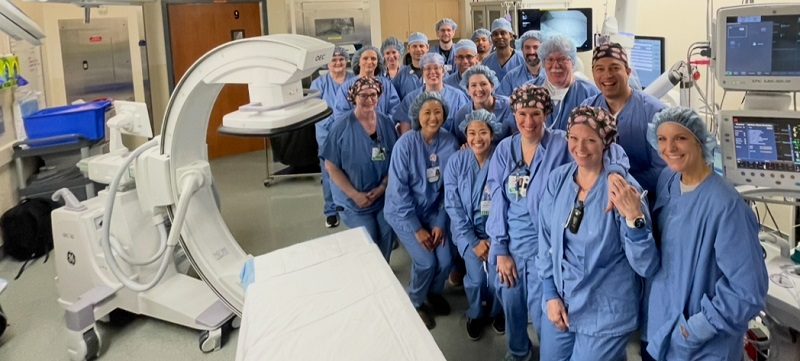
Dominique Pepper, MD, a pulmonologist and bronchoscopist at St. Joseph Medical Center (SJMC) performed the hospital's first biopsy using the new Cone Beam Computed Tomography (CBCT) scanner. Dr. Pepper and his team swiftly identified early-stage lung cancer in the patient, paving the way for immediate and life-saving treatment. Since the first procedure, more than 205 patients have undergone biopsies looking for lung cancer using the new CBCT scanner.
“With this technology, we can now precisely target nodules as small as three, four, or five millimeters,” Dr. Pepper explains. “In the past, patients with lung nodules often heard, 'We'll just watch and wait.' Now, we can definitively tell them, 'We know what this is.”
During the procedure, real-time CBCT imaging provides a precise, live view of a patient's lungs, pinpointing the exact location of the potentially cancerous nodule. This allows pulmonologists to accurately guide a catheter from the patient's mouth along their airways directly to the nodule. Once there, the CBCT can help visualize the nodule, allowing for precise alignment and the efficient collection of a biopsy sample.
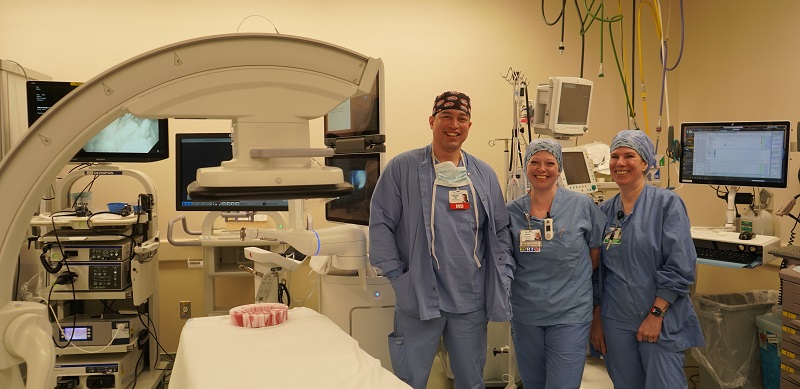
Historically, tiny nodules were often too difficult to reach for accurate biopsy. Dr. Pepper says that with this new technology, accuracy is now more than 95%.
The team pairs the CBCT scanner with its existing robotic bronchoscopy platform, a tool that allows the team to biopsy lung nodules without incisions (cuts) or needle punctures in the chest.
“We now have the ability to take a patient from initial nodule detection to cure and treatment. Our goal is to do it safely, accurately, reliably, and to ensure you receive the best care possible,” Dr. Pepper says.
All patients with concerning nodules receive timely, follow-up care. Pulmonary specialists work closely with thoracic surgery, medical oncology, radiation oncology and the dedicated lung nodule clinic to evaluate findings and determine next steps. In some cases, this collaboration has shortened the time it takes a patient to go from diagnosis to treatment from weeks to just days.
This coordinated approach helps ensure patients receive coordinated, comprehensive care close to home.
A story of early detection and hope
Ruth Jones, a 70-year-old breast cancer survivor, experienced the power of this new technology firsthand. When an unrelated check-up led to a chest X-ray, her primary care physician noticed a "tiny speck" on her images. "Let's take a better look at that," Ruth remembers her doctor saying.
Ruth was quickly referred to a lung nodule specialist at SJMC, Bridget Lonergan ARNP, who determined a biopsy was needed. Within a week, Dr. Pepper performed the procedure using the CBCT scanner. Just a few days later, she received definitive news about the small speck: early-stage lung cancer.
“Dr. Pepper called me personally,” Jones recounts. “He said, 'It's not the news I’d like to deliver. It is cancerous, but we have a plan.'”
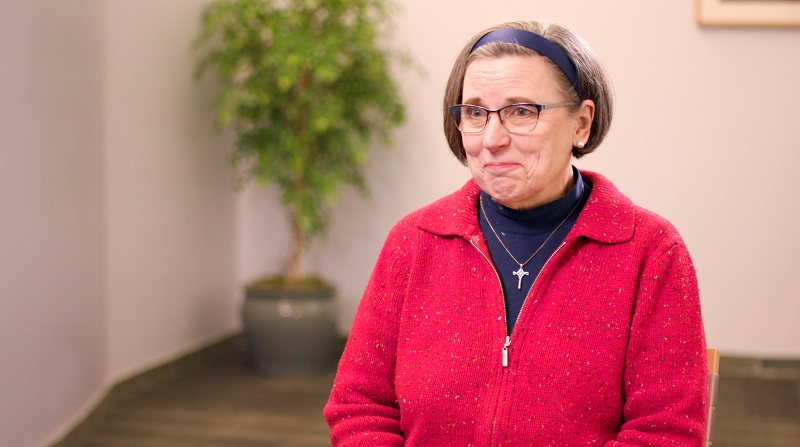
Despite the diagnosis, Ruth describes the biopsy process as simple and efficient. She then proceeded to surgery just a week later, where Thomas (TJ) Templin, MD, a cardiothoracic surgeon at SJMC, successfully removed the 5mm cancerous nodule.
Ruth praises the collaborative team of specialists who carefully and thoughtfully crafted her treatment plan. "I knew that I had a full team of people who were watching over my needs, who had studied my situation, my prognosis, my diagnosis, and they were watching out for me."
A month following surgery, Ruth is already back to walking her dogs around the park and enjoying light yard work. For Ruth, catching her lung cancer at its earliest stage has reshaped her future and her already “look on the bright-side” outlook on life.
“The ability of medical technology to make patient care safer, less stressful is truly remarkable,” Jones said.
A collaborative effort
The addition of CBCT at SJMC was made possible through the VMFH Foundation and generous support from the Seattle Seahawks Crucial Catch and Seattle Kraken Hockey Fights Cancer initiatives, reflecting a shared commitment to advancing cancer care across the Puget Sound.
Lung cancer remains the deadliest cancer, claiming more lives than breast, colon, and prostate cancers combined. The hope is that new technology like CBCT will change this stark statistic. Early diagnosis saves lives.
Uniting advanced technology, powerful community support, and a dedicated care pathway, VMFH is setting a new standard in the fight against lung cancer, offering hope to all patients.