
What are you looking for?
Where did you receive care?
-
MyVirginiaMason has been replaced with the CommonSpirit Patient Portal.
Learn more. -
Virginia Mason Medical Center & regional centers
Log in to Commonspirit Patient Portal > -
All other locations
Log in to VMFH MyChart >

Ray’s Story of Hope and Healing Amidst Pancreatic Cancer
November 2025
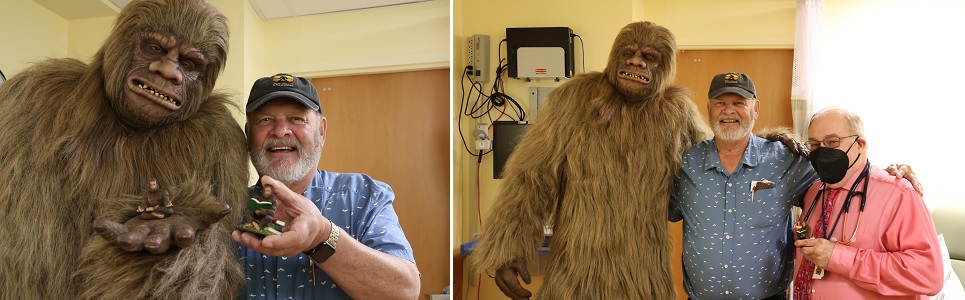
If you find a small sasquatch figurine at Virginia Mason Medical Center (VMMC) in Seattle with an inspirational quote scrawled on the base of the tiny statue’s stand, there’s a good chance 70-year-old Ray George placed it there.
He won’t confirm or deny it was him, but his chuckle reading off the quotes hand-written on the bottom is what truly matters.
“One of them says, ‘sasquatching cancer,’” he said, a big grin on his face. “That’s my favorite.”
Ray loves a good pun–and he thinks sasquatch is the perfect mascot for squatching cancer.
When Ray was diagnosed with cancer, he gave himself a day to grieve. After that, he decided to change his outlook–he viewed cancer as a gift. He turned to humor and small acts of kindness and started living one day at a time, being present and grateful for the small things in life.
If he sees someone sad in the hallways of the hospital, or in a waiting area, he’ll hand them a small sasquatch and make them smile.
His acts of kindness haven’t gone unnoticed, and so at a recent appointment, hospital staff, the Seattle Kraken and a couple Hollywood special effects experts, Doug and Julie Hudson, planned a special surprise for him.
The Seattle Kraken and Virginia Mason Franciscan Health (VMFH) collaborate to educate fans about important health initiatives, offer cancer screenings, celebrate survivorship and fundraise for vital community health initiatives and research, including cancer.
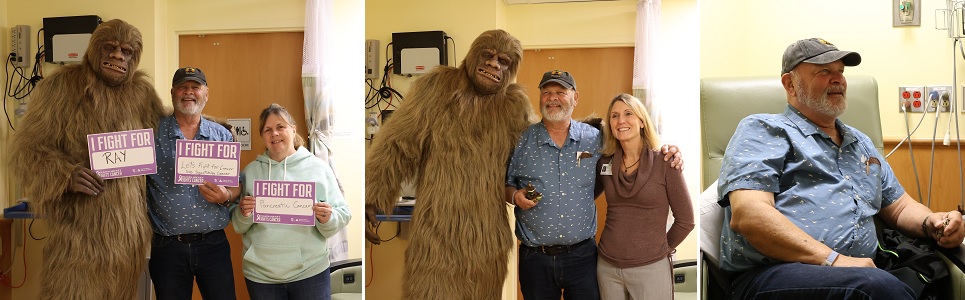
Lumbering through the hospital, the illusive giant himself, sasquatch, made an appearance. He peeked his head through Ray’s room in the outpatient cancer care unit, and immediately, Ray’s face lit up with joy.
“You’ve got to be kidding me,” exclaimed Ray. “That was the best ever,” he said with a big smile on his face.
Sasquatch held up a big sign for Ray–his favorite saying. “Squatch Cancer. You got this, Ray.”
The towering sasquatch was just what the doctor ordered.
A pancreatic cancer diagnosis is a stark reality for thousands, often carrying a grim prognosis. Roughly 66,000 Americans are diagnosed each year, a number that has steadily risen. What makes this disease particularly insidious is its silent nature; symptoms often don't appear until the cancer is advanced.
When Ray began feeling ill last year, cancer wasn’t his first thought–or his second. Honestly, he had never thought much about cancer. He felt like something was off, but he didn’t know what was causing his seemingly benign but pestering symptoms. On Christmas Day, his illness came to a head.
“I really wanted to spend Christmas with my family,” he said, “and I just knew if I went to the hospital, I wouldn’t come out.”
Ray waited until the next morning and went to the emergency room. His intuition was right.
“I got cancer for Christmas,” Ray said jokingly. “It came out of left field and caught me off guard. I learned that day that cancer can hit anyone. It doesn’t care who you are. It’s something you’re never prepared for.”
Risk factors can include a family history of pancreatic cancer, chronic pancreatitis, and conditions like diabetes. The devastating truth is that pancreatic cancer is the third leading cause of cancer-related death in the U.S., with a five-year survival rate of just 13% for all stages combined.
Ray spent 30 days in the hospital near his hometown in Lynden, Washington. After myriad tests and scans, they found a spot on his pancreas. It was devastating news.
“I gave myself one pity day,” said Ray. “Then, I looked at cancer as a blessing.”
Ray was referred to VMFH.
“I chose VMFH,” he said. “We researched, and we found Dr. Vincent Picozzi. He is the best, and I wanted the best.”
Vincent Picozzi, MD, is the director of the pancreaticobiliary program at the Floyd & Delores Jones Cancer Institute at Virginia Mason Medical Center. He’s world-renowned for his care and treatment of pancreatic cancer.
VMFH has been an innovative leader in pancreatic cancer for more than 40 years. Pancreatic cancer survival rates are double the national average, as reported by the National Cancer Institute’s Surveillance, Epidemiology, and End Results Program.
“I was hoping to prolong my life,” said Ray.
At VMFH, the team walks alongside patients like Ray through every step of their cancer journey, combining compassionate, collaborative care with innovative treatment approaches. Virginia Mason Medical Center is a Pancreatic Cancer Center of Excellence as certified by the National Pancreas Foundation, bringing together a team of surgeons, medical and radiation oncologists, interventional gastroenterologists and other specialists to discuss individual cases and formulate comprehensive, personalized treatment plans.
That same commitment to excellence extends beyond medical procedures, addressing the patient as a whole. Kathryn Swingle is a social worker at Virginia Mason Medical Center. Part of her role is caring for a patient’s non-medical needs. She said when she first met Ray, she was inspired by his kindness and humor.
“It’s an honor to work alongside patients with a cancer diagnosis,” she said. “I’m in awe of people’s resilience. If I am having a bad day, I remember what my patients are going through. It fuels me to keep doing the work I do.”
Kathryn spearheaded the formulation of a pancreatic cancer support group eight years ago. It’s a program unique to VMFH. She saw a need in the community and created a space where people with pancreatic cancer could come together. Pancreatic cancer is a devastating disease, and she wanted people to have hope for the future, a place where individuals could share their stories and help each other navigate the uncertainty of cancer.
Ray has been involved in clinical trials and has undergone chemotherapy. He says he hopes his story can help others see a different perspective of cancer.
“The way I look at it, cancer is a blessing,” he said. “If you’re in a fatal car crash or have a heart attack, you don’t get to say goodbye to the people you love. I have time. I may not have years, but I have time with my friends and family, and I’m going to enjoy life while I can.”
Ray is also actively involved in trials to help advance cancer treatment–and one day maybe find a cure.
“I want to help as many people as possible,” he said. “If I can be in a trial to help, I want to. If I can be the cork in the barrel that stops cancer, I want to be that cork. If my story raises awareness for cancer, I want to share it.”
“He lives every day to his fullest,” said Kathryn. “A cancer diagnosis puts mortality right in front of us. It reminds us to enjoy the present because we don’t know what tomorrow is going to bring.”
Ray is doing just that. Everytime he visits VMFH, he has a smile on his face–and a handful of small sasquatch figurines in his pockets. Whenever he can, he brightens someone’s day with a gesture of kindness and encouragement, and he makes people laugh.
As he navigates through the challenges of cancer, he says he hopes he can make a difference in someone else’s life.