
What are you looking for?
Where did you receive care?
-
MyVirginiaMason has been replaced with the CommonSpirit Patient Portal.
Learn more. -
Virginia Mason Medical Center & regional centers
Log in to Commonspirit Patient Portal > -
All other locations
Log in to VMFH MyChart >
Defying the Odds: Laser Therapy Offers New Hope for Brain Tumor Patients
January 2026
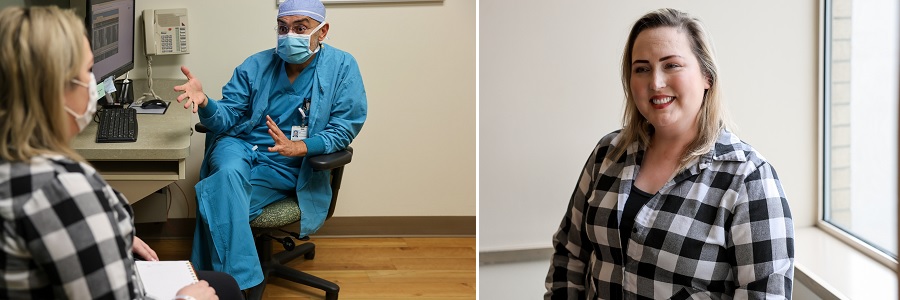
One word turned Molly Redd’s life upside down, not once but twice: cancer.
“I was in disbelief,” she said. “I didn’t think it could happen to me—not at 33 years old. I felt shock, fear and panic.”
Molly was initially diagnosed with breast cancer after unexpectedly discovering a lump. Unfortunately, breast cancer was only the beginning. Molly underwent chemotherapy, radiation therapy, and surgery, followed by more chemotherapy. Then, one day, during the height of the pandemic in July 2020, she suffered a seizure at work.
Scans revealed the unimaginable: Molly had tumors in her brain.
“Hearing you have a brain tumor, it was like it all started all over again,” she recalled.
Given the location of the tumors, surgery wasn't an option to remove them. Targeted therapies worked for a while, but the tumors grew back. She and her partner felt like they were running out of options when Molly’s oncologist referred her to Farrokh Farrokhi, MD, a neurosurgeon at Virginia Mason Franciscan Health (VMFH) who specializes in brain tumors and Laser Interstitial Thermal Therapy (LITT).
LITT employs a surgical tool that uses laser energy to ablate (or destroy) unwanted tissue in the brain, such as a brain tumor. The procedure is MRI-guided, allowing the surgeon to precisely see the specific area of the brain being targeted. Using advanced surgical tools, the surgeon controls the delivery of laser light energy to the affected tissue, which shows up in imaging as darker or lighter spots. The laser light heats and destroys the diseased tissue.
“Molly’s deep-seated tumor in a critical part of her brain made open brain surgery very risky, but she was an ideal candidate for LITT,” said Dr. Farrokhi.
When Molly met with Dr. Farrokhi, he explained LITT and the surgical technique. Together, they evaluated whether the treatment would be right for her.
“He was always so kind,” said Molly. “Dr. Farrokhi always had a smile on his face. I trusted him.”
In April 2024, Molly underwent the procedure.
“As our patients are living longer and healthier lives with cancer, we are seeing more challenging tumors in the brain,” said Dr. Farrokhi. “LITT now offers a low-impact treatment alternative for this population of patients.”
Molly again underwent LITT to remove two more tumors in her brain in 2025.
She said she is now making the most out of life, striving to do all the things she can.
“I am trying to go everywhere I want to go and see all the things I can,” she said. “Quality of life is most important.”
Molly said she’s been spending time with family as much as possible and traveling to the places she’s dreamt of seeing.
“I hope my story can help others who may be struggling,” she added.
She said she’s looking forward to the future, one without cancer.
VMFH is the first organization across a five-state-region to offer LITT. More information can be found at VMFH.org.